Fresno, CA · Garage Door Service
Opener installation for Fresno homes built mostly between 1956 and 1993, matched to the heat load and original hardware you'll find across the valley.
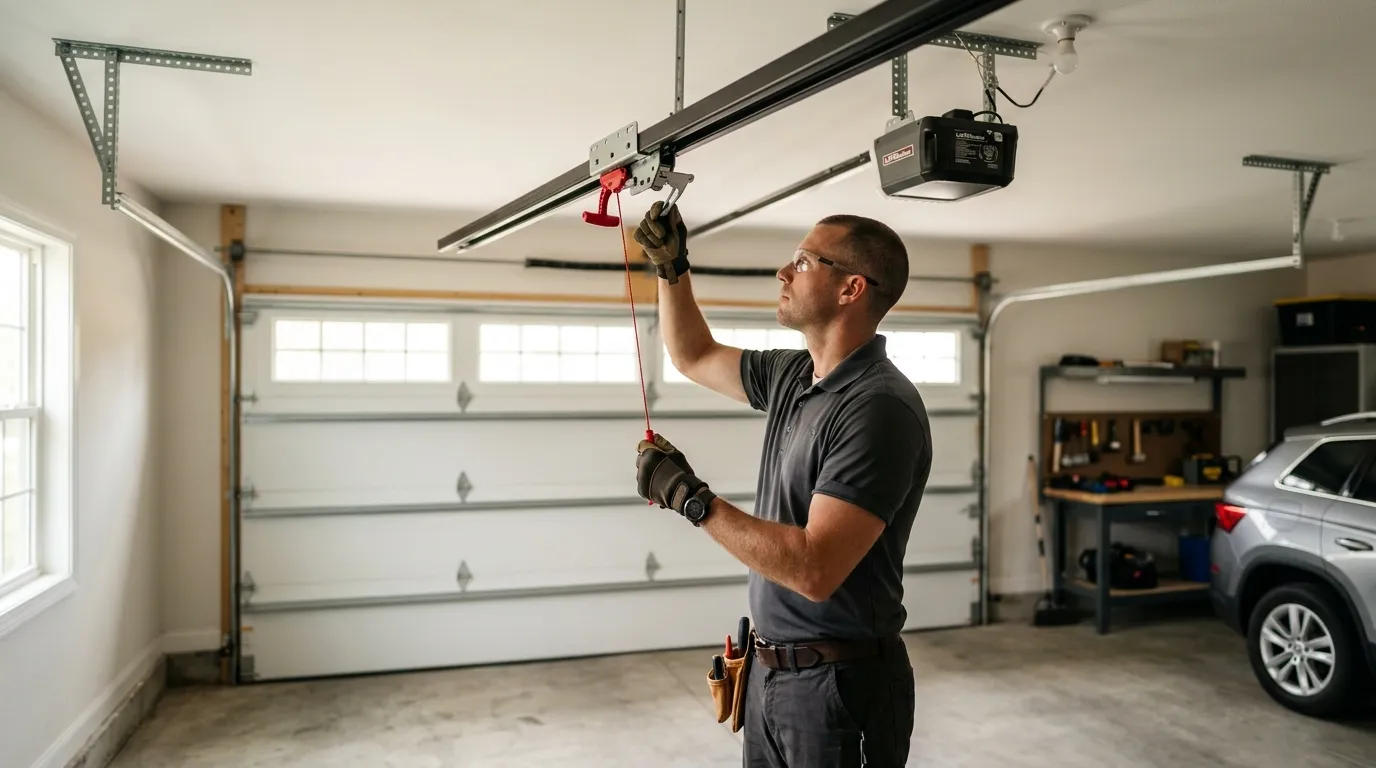
An opener swap is not the same as a spring repair. Once we pull the old unit down, the door itself usually still works on manual pull, so you're not locked out of the garage - you just won't have push-button or remote access until the new unit is mounted, wired, and set to the travel limits of your track.
Most installs on the housing stock common here, built between 1956 and 1993, run in an afternoon. Older chain-drive units on older track sometimes need a bracket or a header reinforcement swapped too, since the original wood framing in houses from that era wasn't always sized for a heavier belt-drive motor. That adds time, not because the opener itself is hard to hang, but because the mounting point has to be solid before we trust a motor to it.
We test the safety reversal and the photo-eye alignment before we leave, every time, regardless of how simple the job looked going in. That part isn't optional and it isn't quick - a motor that closes on an obstruction is a liability we're not willing to hand back to you unchecked.
Fresno's housing stock skews older than a lot of people assume - a median build year of 1982, with most of the service area's homes going up across the 1980s and 90s. Openers from that window, if they're still original, are chain-drive units on capacitor-start motors that were never built for a 40-year service life. When they finally quit, they quit without warning: a capacitor fails, a gear strips, or the logic board gives out from decades of attic heat cycling through the housing.
That heat is the other half of it. Fresno sits in a severe heat climate band, and an opener's motor and control board live right where that heat pools - mounted to the garage ceiling, a few feet from a hot attic space, for months at a stretch every summer. Repeated heat cycling is hard on capacitors, drive belts, and the plastic gearing inside older chain-drive units in particular. It's a slower failure than a snapped spring, but it's just as predictable given the age of the stock we're working with across the area.
What drives the price on an opener install isn't the opener itself so much as what we find behind it. A straight swap - same mount points, same track, working header - is the cheapest version of this job. Add a bracket repair, a header that needs blocking, or a switch from chain-drive to belt-drive with new rail, and the cost climbs with each of those.
We don't quote a number over the phone without seeing the door and the mounting point, because guessing on an old install usually means either underquoting or padding the estimate to cover a problem that might not exist. What we can tell you up front: if your house falls into the common 1956-1993 build range for this area, budget for the possibility of a bracket or header repair alongside the opener itself, not just the unit.
One honest limitation: if your track is warped or your door panels are failing, we'll say so before we hang a new motor on a door that's going to need replacing soon anyway. A new opener on a bad door is money spent twice.
The failure rarely looks dramatic. More often it's an opener that runs louder than it used to, a remote that needs three presses instead of one, or a door that starts to close and then reverses for no visible reason - the photo-eye or the force setting drifting out of tolerance as components age.
Sometimes it's simpler: the motor hums and the door doesn't move at all, which usually means a stripped gear or a failed capacitor rather than anything wrong with the door itself. Homeowners in the older sections of the service area, where original chain-drive units are still common, tend to see the gradual version - months of getting noisier before it finally quits outright.
Either way, the door and the opener are separate systems, and it's worth knowing which one actually failed before anyone touches your wallet. A dead opener with a sound door is a different job, and a different cost, than a dead opener on a door whose track or springs are also on their way out.
Usually, yes. If your house is in the 1956-1993 build range common across this area, the door and track are often original too. We check the header and mounting points before we hang the motor, since older framing sometimes needs a bracket added to carry a modern opener safely.
Chain-drive openers from the 1980s and 90s weren't built to last 40 years, and repeated heat cycling in our climate is hard on their capacitors and gearing. A capacitor or circuit board can fail suddenly even after months of the unit getting slowly louder.
Not for opener installs. What's behind the old unit - the header condition, the mount points, whether the track needs work too - changes the job. We quote after we see it, not before, so the number we give you is the number you pay.
Call now or request a free quote - same-day service on most repairs, upfront written pricing.