Fresno, CA · Garage Door Service
Opener installs for Parlier's 1980s-90s housing stock, priced against a $50,910 median income, done by a Fresno crew that travels the 18 miles out.
In Parlier the call almost never starts with "my opener won't turn on." It starts with the remote working some mornings and not others, or the door reversing halfway up for no reason anyone in the house did. That pattern points at a unit from the original build era straining against gears that have worn past spec. The typical house here went up in 1989, right in the middle of the 1980s-90s wave that makes up most of the housing stock across this end of the service area. Openers from that era are chain-drive, mounted on a rail that's flexed for over thirty years, and the logic boards inside them were never built to survive three decades of Central Valley summers. What you're usually looking at isn't a dead unit - it's a unit doing everything a worn gear and a heat-cooked board let it do, which is not much. Some households still run the original opener with a replaced sensor or two bolted on over the years. That patchwork buys time, but it doesn't buy reliability, and it's usually the reason the door starts acting up right when the weather turns hot instead of failing cleanly all at once.
There's no branch office in Parlier - this crew runs out of Fresno, eighteen miles up the road, so a job here means the truck has to make the drive both ways. That's an honest limitation, not a knock against the town: it just means opener installs get scheduled rather than walked in on. Once the truck is on site, a straight swap - old chain-drive unit out, new unit up on the same rail if the rail's still sound - usually finishes inside a morning. Jobs run longer when the rail itself is bent, when the wiring behind the wall plate predates grounded circuits, or when the header above the door needs reinforcing to hold a heavier unit. None of that is common with a 1989 build, but it isn't rare either at this age. The honest answer is that the door comes off the workday for however long the install takes, not a fixed number, because a house this old sometimes needs an extra hour of electrical work nobody can quote sight unseen.
For a town built out mostly in the 1980s and 90s, the parts that get replaced most are the ones that age at the same rate the houses did: drive gears, chain tensioners, and the safety sensor pairs bolted to the bottom of the track. Those sensors weren't required equipment when a lot of these openers were first installed, so plenty of Parlier houses are running add-on sensors from a later retrofit rather than a matched factory set. A new install replaces the whole sensor pair as a unit - mixing an old sensor with a new opener board is asking for false reversals. Belt-drive units are stocked too, for owners who want the quieter option over the chain-drive standard from the build era. What isn't sitting on the truck is anything custom - a header bracket cut to fit a nonstandard opening, for instance, has to be sourced, and that's the one part of the job that can push a same-week install into the following week.
Mounting the opener head unit is within reach for someone comfortable on a ladder with basic tools - it's mostly four lag bolts and a wire connection. Where it stops being a weekend project is the travel and limit switch calibration, and the force setting on the safety reversal. Set the down-force too high on a door that's had thirty years of spring wear and you've built a machine that will close on whatever's underneath it without stopping. That's not a theoretical risk on a house this age - the springs and the opener are rarely replaced on the same schedule, so the opener often ends up compensating for a door that's already fighting gravity harder than it should. If you're set on doing the mechanical mounting yourself, that's fine; have the force and travel limits checked by someone who does this daily before you trust the auto-reverse with a kid or a pet anywhere near the door's path.
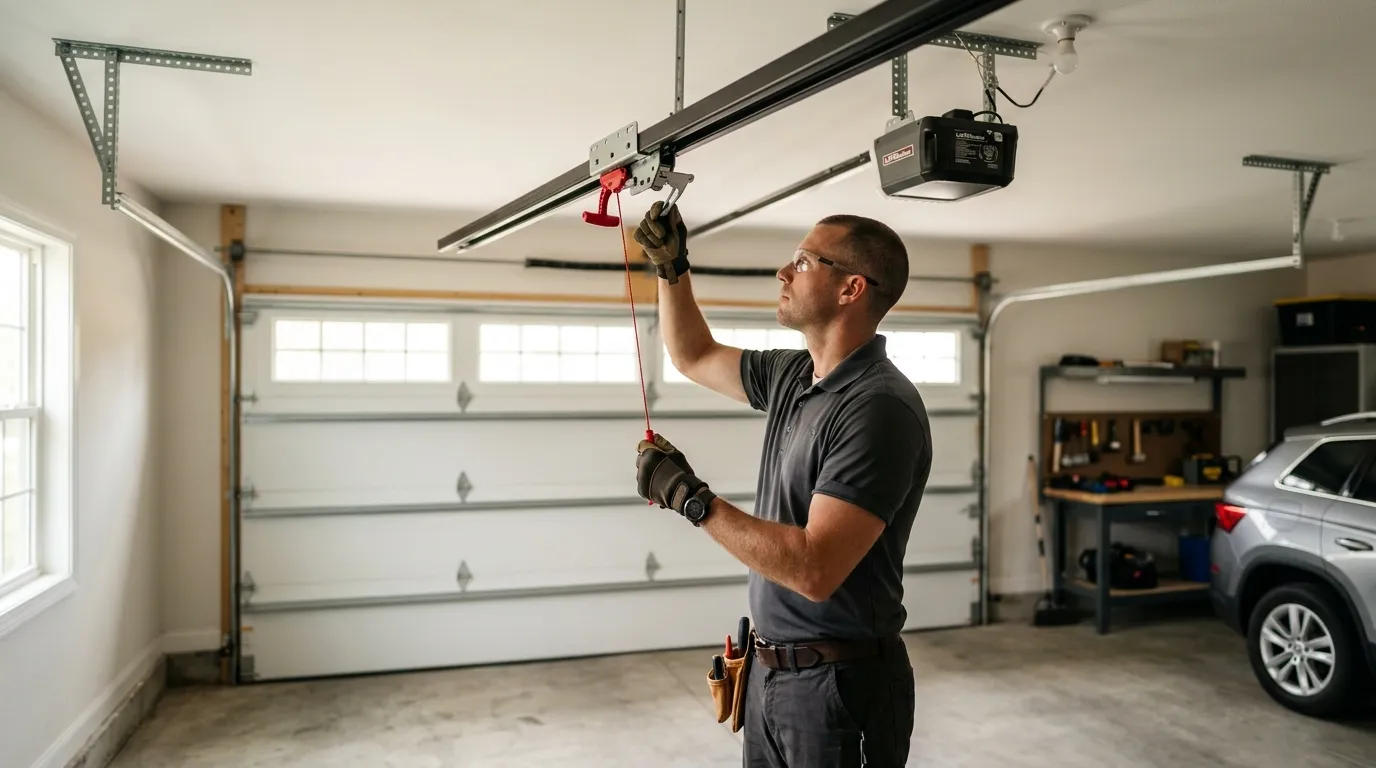
A straight install starts with pulling the old chain-drive head unit and rail, checking the header above the opening for a solid mounting point, and confirming the existing wiring can carry a new unit without running a fresh circuit. On a 1989 build that wiring is usually fine, though occasionally a house wired before opener circuits were standard needs a dedicated line run to the garage. From there it's rail assembly, mounting the head unit, wiring the wall control and safety sensors, and setting travel limits and reversal force to match the door's actual weight - not a factory default. The last step is the one that gets skipped by rushed installs: running the door through a full open-close cycle several times and checking the sensor beam actually stops the door, not just slows it. On an older door with a spring that's lost tension, the fix sometimes has to include a spring adjustment too, because an opener set for a properly balanced door will strain against one that isn't.
The Central Valley's heat band is rated severe, and Parlier sits in the same exposure as the rest of this stretch of the service area. That matters more for openers than for almost any other garage door part, because the circuit board and the capacitor inside the head unit are the components most sensitive to heat cycling - hot attic-adjacent garages by day, cooling off at night, repeated for thirty-plus summers since the median house here went up in 1989. Add a median household income of $50,910, noticeably under the wider area's $62,896, and you get a real pattern: more owners here run an opener well past the point where a Fresno homeowner with more cushion would have already replaced it. That's not a criticism, it's just the math - when the unit still opens the door most days, replacing it competes with everything else the budget has to cover. The tradeoff is that by the time it fails outright, it's usually failed at the worst possible moment, mid-cycle, with the door half up.
If the unit is from the original 1980s build and you're already calling about intermittent behavior, replacement almost always wins - parts for chain-drive units that old are getting harder to source, and a new board runs cooler through the summer heat band than one that's already thirty years into it. Repair only makes sense if the fault is a single, cheap part like a remote battery or a sensor eye.
No. This crew works out of Fresno, about eighteen miles away, and drives out for scheduled jobs. There's no walk-in counter here, so opener installs get booked rather than handled same-visit off the street.
Usually, yes, as long as the door's springs are still holding proper balance. If the door is heavy on one side or the springs are worn, the new opener's force setting has to be adjusted to match, and in some cases the spring itself needs attention first so the opener isn't compensating for a door problem it wasn't built to fix.
Heat is hard on the circuit board and capacitor inside the head unit, and this area's heat band is rated severe. On an opener that's already fifteen or twenty years past its original install, summer heat is often what pushes an intermittent fault into a full failure.
Call now or request a free quote - same-day service on most repairs, upfront written pricing.