Fresno, CA · Garage Door Service
Parlier's houses date mostly from the late 1980s, with steel sectional doors on torsion springs. We drive out from Fresno to fix them, no branch here.
Most houses in Parlier went up around 1989, which puts the majority of doors here in the same generation: single-layer steel sectional panels, no foam core, hung on a standard torsion spring mounted above the opening rather than the older side-mount setup you'd find in an older neighborhood. That construction shows its age in specific ways. The steel panels dent easier than the insulated doors sold today, and thirty-plus years of opening and closing wears the roller brackets loose before anything else fails. You'll hear it before you see it - a grinding or popping on the way up that traces back to a bent track or a roller that's worn its bearing out. On double-wide doors, the center support bracket carries more flex over time, and that's usually where the panel skin starts to bow. None of this is dramatic. It's steady wear on hardware built to a 1980s spec, working exactly as long as it was built to.
We work out of Fresno, about 18 miles from Parlier, so there's no local branch to dispatch from - every call here is a drive, not a walk across a yard. That distance doesn't change what the job takes once we're on site; a spring swap or track realignment runs the same either way. What it does mean is we're not going to pretend we can quote a same-day window before we've heard what's wrong. If a door is stuck shut on a single spring failure, that's a straightforward call. If the opener has died on top of a broken cable, plan on the visit taking longer and possibly a second trip if a part isn't in the truck stock.
Because Parlier's housing stock is concentrated in one era rather than spread across decades, the parts that fail here are predictable: torsion springs sized for a standard 7-foot steel door, nylon rollers, and the steel roller brackets that loosen with age. Those we carry. What we don't always have on the truck is a matching skin panel for a specific door model from that period - steel sectional lines from the late 1980s aren't all still in production, and if a single panel is dented rather than the whole door, sourcing an exact match can take longer than the repair itself. In that case we'll tell you straight whether it's worth waiting on a matched panel or replacing the section with the closest current stock size.
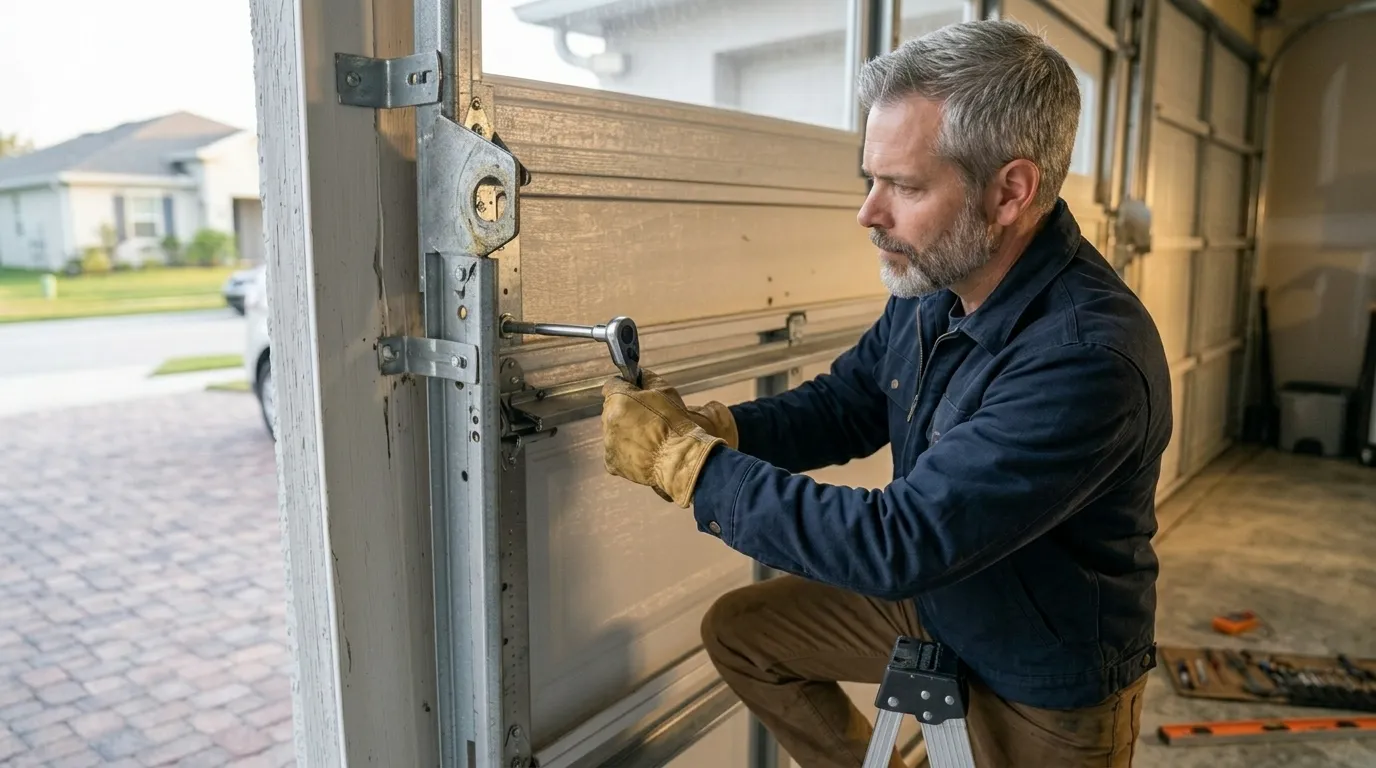
Loose hinges, a track that's knocked slightly out of line, tightening the roller bracket bolts - those are within reach for someone comfortable with a ladder and a socket wrench. A torsion spring is not. It's wound under enough tension to break a wrist or worse if the winding bars slip, and on a standard 7-foot door that spring is carrying the full weight of a steel panel door with no insulation to lighten it. If the door won't move at all, or moves and then drops, that's spring or cable territory - stop there and call it in rather than working it out yourself.
A torsion spring replacement on one of these doors starts with releasing tension on the existing spring with winding bars, pulling the old spring and shaft bearing, then setting a replacement sized to the door's actual weight - steel sectional doors from this era generally run heavier than today's insulated equivalents, so getting the spring size wrong means a door that won't stay put. Roller and bracket work is more mechanical: pull the worn rollers, check the track for bends caused by the bracket flexing loose, and reset alignment before buttoning it back up. On a double door with a center support that's started to sag, we check whether the bracket itself needs replacing before touching the springs, since a sagging support can throw off spring balance even with new springs installed.
Parlier's median household income sits at $50,910, well under the roughly $62,896 median across the wider Fresno service area, and that gap shows up in how repairs get handled here - more patch-and-fix requests on aging steel doors, fewer full replacements before the door's actually done. With around 3,587 households in Parlier, most sharing that same late-1980s build era, the failure pattern doesn't vary much house to house: it's the same torsion spring, the same roller wear, the same non-insulated steel panel flexing under Central Valley heat. That heat matters more than people think - repeated expansion and contraction on steel panels through severe summer heat loosens fasteners and warps thin steel over the years faster than it would in a milder climate.
If your house was built around the late 1980s, like most of Parlier's stock, you likely have a non-insulated steel door - heavier than today's foam-core doors of the same size. Add a weakening torsion spring and that weight becomes obvious fast. A properly balanced door should lift with one hand; if it doesn't, the spring is losing tension.
No. We work out of Fresno and drive out to Parlier for calls, about 18 miles each way. There's no local depot here, so we schedule the visit around the job rather than promising a walk-in response time.
Sometimes, sometimes not. Steel sectional doors from the late 1980s came from manufacturers who've since changed or discontinued lines. If your door needs one dented panel replaced, we'll check what's available before promising an exact match - a full section swap with the closest current stock is sometimes the more honest fix.
Depends on what's failing. A spring or roller issue on an otherwise sound steel door is a straightforward, worthwhile repair. But if the panels are dented across multiple sections or the door's been rebalanced repeatedly, replacement often costs less over time than chasing parts for a 35-year-old door.
Call now or request a free quote - same-day service on most repairs, upfront written pricing.