Fresno, CA · Garage Door Service
Easton's houses mostly date to the early 1970s, a decade older than the median build across Fresno's service area. That gap changes what breaks and what parts a repair needs.
Across the wider Fresno service area, the median home was built in 1982. Easton runs older - most houses here went up around 1971. Eleven years doesn't sound like much until you're standing in front of the door. A 1971 garage was built for a lighter door, often with a two-spring setup on hardware that newer torsion systems replaced by the mid-80s. The tracks are narrower, the drums are a different diameter, and the brackets don't always match what's on the truck for a newer install.
Easton sits about 9 miles from Fresno, which matters less for how fast we can get there and more for the fact that this pocket didn't get the same wave of production-home construction that reshaped a lot of the rest of the area in the 80s and 90s. Houses here were mostly finished before that boom started, so the door and opener installed the first time is more likely to still be the one working - or failing - today.
The heat here runs severe, same as the rest of the region, and that's hard on rubber seals, nylon rollers, and any opener with sun-baked wiring in an uninsulated garage. On a door already a decade past its expected hardware life, heat stress tends to be the thing that finishes the job a worn spring started.
On the older stock in Easton, the complaint we hear most is a door that won't open all the way, or opens partway and stalls. That's usually a torsion spring that's lost tension - original hardware from a 1971 build has had five decades to fatigue, even with lighter use. A door that slams down instead of lowering smooth is the same story: the spring isn't carrying its half of the weight anymore, and the opener motor is doing work it wasn't built to do.
Cracked or brittle panels show up more here too. Steel and wood doors from the early 70s weren't galvanized the way later doors were, and after enough summers in this heat band, panels rust through at the bottom corners or warp along the seams. You'll notice a gap of daylight at the bottom that wasn't there before, or a door that no longer sits flush in the track.
Openers on these older houses are frequently a second or third replacement unit bolted onto original track and rail - which means the safety sensors don't always line up with where the door actually travels. If your opener reverses for no reason, or the light blinks without an obvious obstruction, that mismatch is often why.
We carry torsion springs sized for both older two-spring setups and the single-spring torsion bar systems that came later, since Easton's housing mix means we don't know which one we'll find until we're standing at the door. Rollers, cables, and standard-width tracks are on the truck for both eras.
What we don't always have on hand is a matching bracket or drum for a door that's been patched over the years with parts from different decades - that's common on original doors this old, and it sometimes means a short wait on a specific part rather than a same-visit fix. We'll tell you straight if that's the case before we start, not after.
Weatherstripping and bottom seals get replaced more often out here given the heat, and we stock the standard profiles. Opener parts - logic boards, sensor pairs, drive gears - cover the common brands installed as replacements over the last couple decades, since that's what we're more likely to be servicing than a factory-original 1971 unit.
We don't quote a price without seeing the door - a torsion spring swap on a single door costs less than replacing a warped panel or an opener with a fried board, and Easton's older stock means we see more of the latter two than newer subdivisions do. What we can tell you is that household income here runs higher than the area-wide median of $62,896, which sometimes means homeowners choose full replacement over patching an original door that's already at the end of its practical life, rather than sinking money into hardware that's this old.
That's a judgment call, not a sales pitch - a well-maintained door from 1971 can still be worth repairing if the panels are sound and it's just a spring or cable. But if we're pulling a second or third part off a door that age, replacement usually costs less over the next five years than repeat service calls.
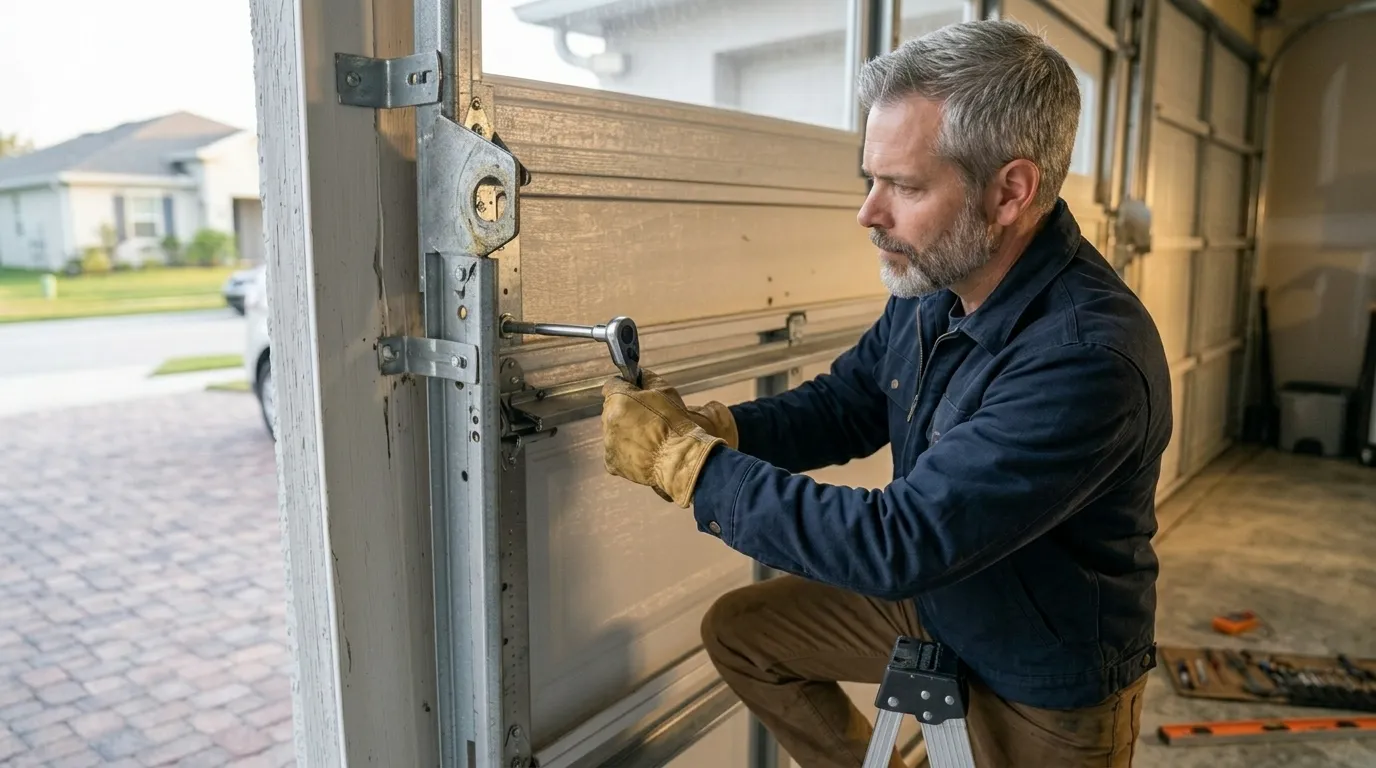
Don't touch a wound torsion spring. It doesn't matter how old or new your door is - the spring is under enough tension to break a wrist or worse, and that risk doesn't change with the decade your house was built. Leave spring work, cable work, and anything involving the torsion bar to someone with the right bars and clamps.
What you can do yourself: check that the tracks are clear of debris, tighten loose hinge bolts by hand, and test the auto-reverse safety feature by placing a piece of wood in the door's path. If it doesn't reverse, stop using the opener until it's looked at.
On a door this old, we'll also tell you honestly when a repair isn't worth doing - if the panel steel is rusted through in more than one spot, patching it is a short-term fix, and we won't pretend otherwise just to get a smaller job.
Most Easton homes date to around 1971, roughly a decade older than the area's median build year of 1982. Doors from that era often ran two-spring torsion setups with narrower tracks than what became standard later, so hardware sizing and bracket types can differ from a repair on a newer house.
No. We work out of Fresno and travel to Easton, about 9 miles away, for service calls. There's no separate depot here - the truck and parts stock come from the same base that covers the rest of the service area.
Depends on what's wrong. A spring, cable, or roller repair on a sound 1971 door is often worth doing. If the panel steel has rusted through or the frame's warped, repair is usually a short-term patch - we'll say so plainly rather than charge for a fix that won't hold.
This area sits in a severe heat band, and prolonged sun exposure on an uninsulated garage stresses wiring and sensor alignment over time. On older houses where the opener has been replaced more than once, sensor brackets sometimes don't quite match the original door travel, which the heat can make worse.
Call now or request a free quote - same-day service on most repairs, upfront written pricing.